
Basement Floor Leveling Guide: Grinding, Patching, or Self-Leveling?
Uneven basement slabs telegraph through subfloors and finishes, causing hollow sounds, seam stress, and wavy lines. Before you choose LVP, carpet, tile, or engineered wood, map the slab, correct highs and lows, and plan total height so doors, stairs, and thresholds land perfectly. In Terre Haute and across Vigo County, the right leveling method, grinding, patching, or self-leveling underlayment, keeps floors flat, quiet, and moisture-safe for Indiana basements.
Quick Answer for Indiana Basements
For Terre Haute and Vigo County homes, pick the fix by what you see: grind isolated humps, patch narrow dips ≤ 1/4″, and use self-leveling underlayment (SLU) when broad areas are out of plane or you need a uniform surface fast. Hit a slab flatness tolerance of 1/8″ over 6′ (or 1/4″ over 10′) before any subfloor so LVP, carpet, or engineered wood won’t telegraph imperfections. Plan total height early so thresholds and stair risers stay within code.
Quick rules
- Grind high spots (crowns/ridges) and blend edges to the surrounding concrete
- Feather-finish patch low areas under ~1/4″; let each lift cure, then re-check
- Choose SLU for large uneven fields or tile prep that needs a true reference plane
- Coordinate leveling with your subfloor build (foam/panels/sleepers) and keep indoor RH ~40–50% during cure for reliable bond
How to Measure Flatness (and Decide Your Fix)
Start by mapping the slab so you’re not guessing. Sweep clean, then use a long straightedge/level in multiple directions to spot crowns (high ridges) and dips (low pockets). In larger Terre Haute basements, a laser or rotary level helps you visualize a consistent datum plane, especially if you’re planning sleepers or foam thickness. Photograph your marks and note approximate depths; that record drives materials, cost, and height build.
Flatness check (6 quick steps)
- Snap a chalk grid (about 3–4′ squares) so readings are organized
- Slide a 6–8′ straightedge; mark red for ridgelines and blue for puddles
- Note gap/rock amounts (e.g., 1/8″, 3/16″) next to each mark
- Use a laser/line level to confirm plane across doorways and long runs
- Re-check traffic paths and where telegraphing under LVP would be most visible
- Log totals by zone to estimate grind/patch/SLU quantities and height impact
How to choose the method
- Mostly red ridgelines? Prioritize grinding high spots and blend edges into the surrounding concrete.
- Scattered blue puddles ≤ 1/4″? Use a feather-finish patch in thin lifts, then re-check flatness.
- Broad areas out of plane? Pour self-leveling underlayment (SLU) to create a uniform reference surface for subfloors or tile.
Targets to keep in mind: hit 1/8″ over 6′ (or 1/4″ over 10′) before installing any subfloor so floors stay flat and quiet in Indiana’s mixed-humid conditions. Documenting this map up front helps you plan thresholds, stair risers, and total height for Vigo County homes without last-minute surprises.
Fix Options Compared (At-a-Glance)
Use this quick chart to choose the right leveling method for Indiana basements (Terre Haute, Vigo County) based on slab condition, speed, and height impact.
| Method | Best for | Speed | Height impact | Typical installed range* |
|---|---|---|---|---|
| Grinding high spots | Isolated humps and ridges | Fast | Minimal | $1.50–$3.50 / sq ft (affected areas) |
| Patching low areas | Narrow dips ≤ 1/4″ deep | Moderate | Minimal | $2.00–$4.00 / sq ft (affected areas) |
| Self-leveling underlayment (SLU) | Broad uneven fields, tile prep | Moderate–Fast | Adds 1/8″–3/4″ | $3.50–$6.50 / sq ft (area poured) |
*Indiana labor + materials; final cost varies with room size, access, moisture detailing, and whether work is bundled with subfloor installation.
How to use this table
- Grind crowns/ridges first to prevent telegraphing under LVP.
- Feather-finish patch scattered “puddles” under ~1/4″, then re-check flatness.
- Choose SLU when large zones are out of plane or tile needs a true reference surface.
- Recalculate total height with your chosen subfloor (foam/panels/sleepers) and plan thresholds/stair risers.
Grinding High Spots
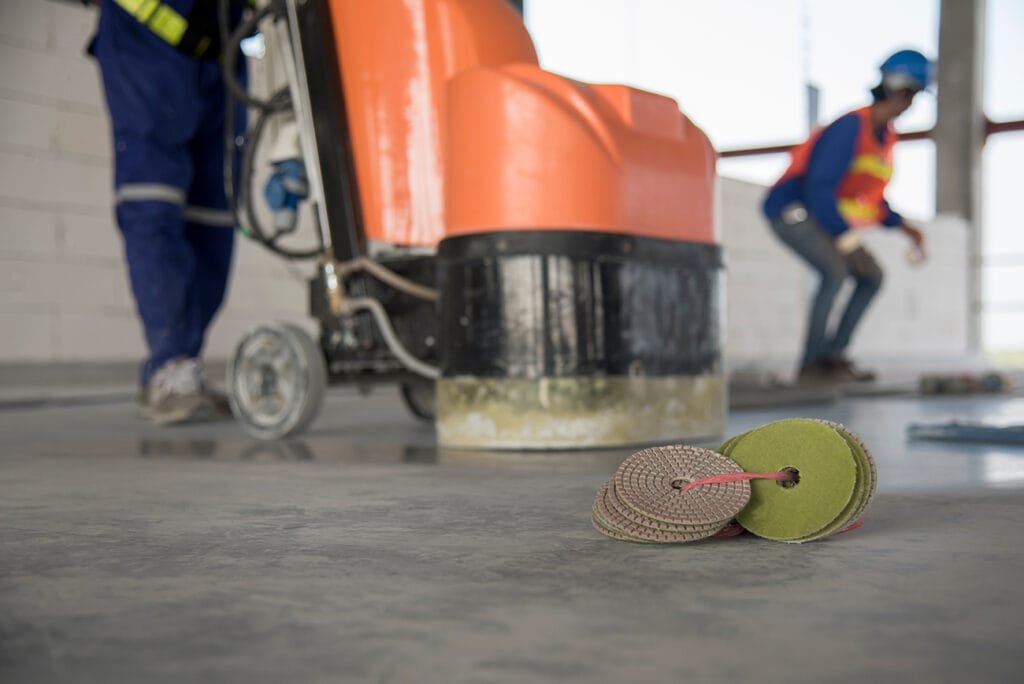
Grinding knocks down ridges and crowned joints so subfloors sit flat and quiet. Use a diamond cup wheel with a dust shroud and vacuum, keep passes smooth, and blend edges into the surrounding slab so you don’t create new lips. Check progress often with a long straightedge and re-map the slab when you’re done; many Terre Haute basements only need light patching after crowns are removed.
6-step process
- Protect adjacent finishes and set up dust control with a shroud + vac
- Mark crowns/ridges from your flatness map so you’re only removing what’s needed
- Make shallow, overlapping passes; blend transitions to avoid new high/low edges
- Pause to vacuum and check with a 6–8′ straightedge in multiple directions
- Feather remaining shallow “puddles” with patch if they’re under about 1/4″
- Re-check flatness targets (1/8″ over 6′ or 1/4″ over 10′) before subfloor install
Watch-outs
- Don’t chase deep crowns endlessly; sleepers or SLU may be more cost-effective
- Verify there’s no near-surface steel (old mesh/ties) before aggressive grinding
- Manage dust and silica exposure; containment matters in occupied Indiana homes
- Blend to surrounding concrete so LVP or panels don’t telegraph a hard edge
Patching Low Areas
Cementitious, polymer-modified patch compounds feather cleanly into shallow depressions and trowel smooth, making them ideal when you want minimal height gain but solid bearing under interlocking insulated panels or foam-and-ply systems. Prime as required, mix to the manufacturer’s ratio, fill dips in thin lifts, and let each lift fully cure before the next. After cure, rub down trowel lines, vacuum, and re-check flatness so LVP or engineered wood won’t telegraph. In Terre Haute and across Vigo County, this approach is a cost-steady way to prep slabs that are mostly true.
6-step method
- Mark “puddles” from your flatness map and prime only those zones (or full field if specified)
- Mix a polymer-modified feather-finish patch to workable consistency, no dry lumps
- Trowel the first thin lift, feathering edges tight to surrounding concrete
- Allow the lift to cure per the bag (temperature/RH matter), then spot sand high ridges
- Apply a second thin lift where needed; keep the assembly flat, not proud
- Vacuum, then verify targets (1/8″ over 6′ or 1/4″ over 10′) before subfloor install
What to watch
- Compatibility: Ensure the patch and primer play nice with your membrane, foam seam tape, or adhesive
- Moisture & RH: Keep indoor RH ~40–50% for predictable cure and bond; avoid patching over damp, darkened concrete
- Scope creep: If dips exceed ~1/4″ across broad areas, switch to SLU or consider sleepers for a truer plane
- Transitions: Recheck thresholds and stair risers, even thin lifts change total height in tight Indiana basements
Self-Leveling Underlayment (SLU)
When large zones are out of plane, or tile needs a uniform substrate SLU delivers a true reference surface with fewer surprises. Dam doorways and penetrations, prime per manufacturer specs, and pour within working time. Use a gauge rake to set depth and a spiked roller to release air. After cure, you’ll have a flat base ready for dimpled membranes, foam + plywood, or tile uncoupling layers ideal for Indiana basements where telegraphing ruins finishes.
6-step SLU method (Terre Haute tested)
- Prep & contain: Sweep, vacuum, and dam thresholds/penetrations; mask adjacent finishes.
- Prime correctly: Apply the required primer at the right spread rate; respect dry-to-pour window.
- Mix precisely: Batch with clean water, consistent ratios, and continuous mixing to avoid cold joints.
- Place & gauge: Pour, then use a gauge rake to target depth (often 1/8″–3/8″); maintain a wet edge.
- De-air & blend: Roll with a spiked roller to release bubbles and blend lifts; check edges for laps.
- Cure & verify: Protect from drafts; maintain indoor RH ~40–50%; after cure, verify flatness (1/8″ over 6′).
Watch-outs
- Height build: SLU adds ~1/8″–3/4″ so plan thresholds and stair risers before you pour.
- Moisture & dew point: In humid Indiana months, confirm the slab isn’t at/near dew point; don’t trap moisture below.
- Bond & primer: Wrong primer or missed coverage leads to debond. Follow the bag, not guesses.
- Sequence: Respect cure times before installing membranes, foam, or tile; rushing invites failure.
Pairing SLU with subfloors
- Interlocking panels: Great after a thin SLU skim in wide rooms, quiet feel, minimal height.
- Foam + plywood: SLU first for broad uneven fields; then float foam sheets and T&G ply.
- Dimpled membrane + ply: SLU helps reduce hollow spots and fastener telegraph.
- Tile + uncoupling: SLU to flat, then uncoupling membrane for movement tolerance.
Height & Threshold Planning
Every leveling choice changes finished floor height. Before you pick grinding, patching, or self levelling underlayment especially when pairing with foam, panels, or sleepers, map exterior doors, stair noses, appliances, vents, and transitions. In Terre Haute homes, planning total build now (e.g., 1/8″ grind/patch + 1″ foam + 3/4″ plywood + LVP) keeps stair riser variance and door undercuts within code and avoids awkward reducers later.
8-point planning checklist
- Calculate total build: Add leveling layer + subfloor (foam/panels/sleepers) + sheathing + finish (LVP/carpet/tile). Write the number down for each room.
- Stair math: Keep riser variation ≤ 3/8″ (IRC) from bottom to top after the new floor. Adjust landings or nosings if needed.
- Exterior doors: Decide on flush vs reducer. Confirm threshold seals still compress and you can clear any sweep weatherstripping.
- Interior doors: Plan undercuts for the chosen finish and pad. Don’t forget bath/laundry doors if you changed height nearby.
- Transitions: Choose reducers/T-molds that match the final thickness (don’t guess). Pre-order trims if lead times are long.
- Appliances & built-ins: Check fridge wheels, laundry pedestals, cabinet toe-kicks, and clearances under counters—height adds up fast.
- Registers & cleanouts: Extend collars/trim rings to the finished height; preserve access to cleanouts and shutoffs.
- Slope & water paths: Near entries or sumps, maintain any intentional drainage slope and leave a tidy reveal at the sump basin.
Moisture, RH, and Bond
Leveling only works if products bond and the assembly can dry. In Terre Haute’s mixed-humid climate, verify the slab isn’t actively wet, manage indoor relative humidity (RH) ~40–50% during cure, and avoid trapping poly layers, especially beneath sleepers so seasonal drying still happens.
A quick moisture game plan
- Spot test the slab: Tape a 2×2 ft plastic sheet for 24–48 hours; look for fogging or darkened concrete (basic capillary/vapor check).
- Scan for efflorescence: Salty/white deposits along edges or cracks signal moisture paths; clean and address before patch/SLU.
- Prime where required: Use the manufacturer-specified primer for patch or self-leveling underlayment (SLU); wrong primer = poor bond.
- Control indoor RH: Hold 40–50% RH with ventilation or a dehumidifier so cementitious layers cure predictably.
- Mind dew point: Cold slabs + humid air = condensation risk. Keep the interior surface warm (thermal break) and air dry during cure.
- Document readings: Note RH/temp and any meter readings before you install membranes, foam, or subfloors helps with warranty and troubleshooting.
What to avoid
- Trapped poly between layers that blocks dry-out (common under sleepers)
- Patching or pouring over damp, darkened concrete without addressing source moisture
- Skipping primer or using the wrong product, leading to debond or pinholes
- Sealing off sump/penetration edges without a planned, durable moisture detail
Typical Cost Ranges in Indiana
Compare baseline installed pricing for Terre Haute/Vigo County (materials + labor). Actual totals vary with slab condition, access, moisture detailing, and whether work is bundled with subfloor installation and height planning.
| Method | What’s included | Typical installed range |
|---|---|---|
| Grinding high spots | Mapping, dust-controlled grinding, edge blending | $1.50–$3.50 / sq ft of affected areas |
| Patching low areas | Primer (if required), feather-finish lifts, touch-up sanding | $2.00–$4.00 / sq ft of affected areas |
| Self-leveling underlayment (SLU) | Primer, damming, mixing/pour, basic surface prep | $3.50–$6.50 / sq ft of area poured |
Notes
- Prices assume typical Indiana basements and standard slab flatness tolerance goals (≈ 1/8″ over 6′).
- Add-ons: moisture mitigation, tight access, or extensive height/threshold planning may push totals higher.
Which Method Pairs Best With Your Subfloor?
Match the leveling approach to your subfloor so finishes stay flat and quiet. In Terre Haute/Vigo County, the goal is uniform bearing with minimal height build and no telegraphing under LVP or engineered wood.
Pairing guide
- Interlocking insulated panels: Grind ridges first, then light patching as needed. Panels like a broadly flat slab for warm, quiet performance.
- Foam + plywood (floating): Prioritize aggressive ridge removal and feather small dips; this system rewards a wide, even plane.
- Dimpled membrane + plywood: Benefits most from uniform bearing; a thin SLU skim in larger rooms can eliminate hollow spots.
- PT sleepers + infill: Choose sleepers when the slab is truly wavy or out of level, level in the sleeper layer, then add foam/mineral wool for warmth.
Frequently Asked Questions On Basement Floor Levelling In Indiana
Do I need to level the slab if I’m using interlocking insulated panels?
Usually just the ridges and obvious dips. Panels perform best on a broadly flat slab floor, grind high spots and feather-finish patch shallow pockets so the system bears evenly and doesn’t telegraph under LVP.
How do I decide between grinding, patching, and SLU?
- Grinding for isolated crowns/ridges
- Patching for scattered dips ≤ 1/4″
- Self-leveling underlayment (SLU) for broad areas out of plane or tile-ready surfaces
- Map first with a straightedge/laser, then choose the least-height, most-predictable fix.
Can moisture ruin patch or SLU bond?
Yes. Keep indoor RH ~40–50%, prime as specified, and avoid pouring over damp, darkened concrete. Do a 24–48 hr taped-plastic test if you’re unsure, and address efflorescence first.
If my slab is really wavy, should I still try to level it?
When waves are widespread, PT sleepers + foam/mineral wool infill may be smarter than heavy SLU. Sleepers let you establish a true plane while adding a thermal break for Indiana basements.
What flatness tolerance should I hit before subfloors or LVP?
Aim for 1/8″ over 6′ (or 1/4″ over 10′). Tile is stricter. Hitting these targets in Terre Haute/Vigo County keeps floors quiet, seams tight, and transitions clean.
Will SLU add too much height under doors and at stairs?
SLU adds roughly 1/8″–3/4″. Plan thresholds and stair riser math before you pour, and coordinate with the total subfloor build (foam/panels/sleepers + sheathing + finish).
Is leveling messy or dusty?
Grinding creates dust without proper containment so use a cup wheel with shroud + vac. SLU is cleaner but needs dams, primer, and careful mixing. We contain, vent, and clean so homes stay livable.
How much does leveling cost around Terre Haute?
Typical installed ranges: grinding $1.50–$3.50/sq ft (affected areas), patching $2.00–$4.00/sq ft (affected areas), SLU $3.50–$6.50/sq ft (area poured). Final price depends on slab condition, access, moisture detailing, and whether it’s bundled with subfloor installation.

Need further assistance?
Unsure about something? Get in touch with us for a personalized consultation.
Ready for Flat, Quiet Basement Floors?
Let’s map your slab, pick the right fix, grind, patch, or self-level and plan height so doors, stairs, and thresholds land perfectly. Serving Terre Haute, Vigo County, and nearby Indiana communities.
Serving Terre Haute, Clinton, Rockville, and surrounding areas.
