
Basement Radon Testing & Mitigation in Terre Haute, Indiana
A dry, finished basement still isn’t complete if radon isn’t addressed. Radon is an odorless, invisible gas that can enter through slab cracks, cold joints, and sumps. Because basements sit below grade under slight negative pressure, readings can be higher downstairs than on upper floors. Testing is quick, and mitigation is straightforward to integrate during framing so you don’t have to open walls later.
TL;DR
Radon gas can seep into basements through cracks and sumps, especially in Indiana’s clay soils. Testing before basement finishing is quick and inexpensive, and sub-slab depressurization (SSD) systems safely vent gas outdoors. A sealed sump lid, proper fan, and balanced airflow keep your Terre Haute basement healthy year-round.
Why test in West-Central Indiana
Basements in Terre Haute and the wider Wabash Valley sit against soils that can channel soil gas into homes, especially during the heating season when negative pressure and the stack effect pull air from the ground. Foundation type (poured concrete, block walls, slab-on-grade, crawl-to-basement transitions), drainage details, and HVAC balance all change how much radon enters, sometimes house-to-house on the same street. The only way to know your level (in pCi/L) is to test before finishing and re-test after any mitigation or major HVAC changes.
What makes local basements higher risk
- Tight homes + winter heating create negative pressure that draws gas through slab cracks, cold joints, and the sump basin.
- Clay-rich soils and interior drain tile can concentrate soil gas pathways under the slab.
- Unsealed penetrations (plumbing sleeves, electrical conduits) act like straws for sub-slab air.
- Imbalanced HVAC (supply without a true return in the basement) pulls air from the slab instead of circulating it.
Testing plan for Vigo, Vermillion, and Parke counties
- Screen with a short-term test in the lowest livable level under closed-house conditions.
- If results approach or exceed the action level, plan a sub-slab depressurization (SSD) stub during framing.
- After the system is running, confirm with a follow-up test (or a long-term alpha-track for seasonal accuracy).
- Re-test after major changes (new furnace, ductwork, added returns) or if you remodel adjoining spaces.
Helpful terms to include in your notes
- radon testing kit, short-term charcoal, long-term alpha-track, continuous monitor
- action level (pCi/L), sub-slab depressurization, sealed sump lid, drain tile connection
- soil gas, stack effect, negative pressure, foundation wall penetrations
Quick takeaway: Indiana basements vary widely, even on the same block. A 48–96 hour screen before you build out walls is the fastest way to protect indoor air quality and avoid opening finished surfaces later.
Action levels and the testing game plan
Radon levels are measured in picocuries per liter (pCi/L), and the EPA’s action level for mitigation is 4.0 pCi/L. Anything above that warrants corrective action, while even levels between 2.0–4.0 pCi/L benefit from ventilation and sealing improvements. Testing tells you where you stand and helps guide next steps before you finish the basement.
Recommended testing plan for Terre Haute homeowners
- Run a short-term radon test in the lowest livable level before finishing. These charcoal or electret tests provide a quick snapshot (48–96 hours) of soil gas entering the home.
- If results are near or above 4.0 pCi/L, plan for a mitigation stub or suction point while the basement walls are still open. It’s the cheapest time to add a sub-slab depressurization (SSD) system.
- After installation, re-test using a long-term alpha-track or continuous radon monitor to confirm the system’s performance over different seasons.
- Re-check periodically or when making HVAC changes (new furnace, added returns, sealed ducts) since airflow and pressure shifts can alter radon draw.
How to interpret results
- Below 2.0 pCi/L: Ideal—monitor every few years.
- 2.0–4.0 pCi/L: Acceptable but worth mitigation prep during finishing.
- Above 4.0 pCi/L: Install or activate a mitigation system right away.
Local testing tips for Indiana basements
- Test in closed-house conditions (windows shut, HVAC running normally).
- Place kits 3–6 ft off the floor in a livable zone, away from drafts, exterior walls, or sump openings.
- Avoid running fans, dehumidifiers, or air purifiers nearby during the test period.
- Use EPA-listed radon test kits or certified professionals familiar with Indiana Radon Program standards.
Key terms to understand
- Action level: Threshold (4.0 pCi/L) where mitigation is recommended.
- Short-term test: 2–7 days, quick screening using charcoal canisters or electret detectors.
- Long-term test: 3–12 months, more accurate average using alpha-track detectors.
- Continuous radon monitor (CRM): Electronic device used by pros for real-time readings and diagnostics.
- Sub-slab depressurization (SSD): The standard system that pulls radon from beneath the slab and vents it outside.
Quick takeaway
Radon levels fluctuate with season, soil moisture, and ventilation. Testing before drywall is the best way to integrate radon mitigation cleanly, protecting your finished basement’s air quality, resale value, and long-term safety.
How radon gets in (and how we stop it)
Basements in Terre Haute can pull soil gas through the tiniest openings. Stack effect, negative pressure during heating season, and interior drain tile pathways all encourage radon to migrate from the soil into the lowest level. If there’s a path, it will use it, just like water.
Common entry points in Indiana basements
- Hairline slab cracks, saw-cut control joints, and shrinkage cracks
- Perimeter slab edges and cold joints at footings and stem walls
- Sump basins, unsealed sump lids, and interior drain tile terminations
- Utility penetrations: plumbing sleeves, electrical conduits, HVAC chases
- Unsealed expansion joints beneath partition walls and stair landings
- Open framing chases and the rim-joist/sill-plate line
First line of defense: sealing and isolation
- Seal visible slab cracks and joints with polyurethane or epoxy crack sealant
- Collar and caulk around pipe penetrations and conduit sleeves; use airtight grommets where possible
- Install a sealed, gasketed sump lid with a viewing port and grommeted penetrations for pump lines
- Foam, tape, and seal mechanical penetrations, the rim joist, and sill-plate gaps to cut stack-effect leaks
Why sealing helps but isn’t the whole solution
Sealing reduces uncontrolled make-up air and lowers the pathways radon can exploit, improving sub-slab communication for a mitigation system. It’s a key prep step before sub-slab depressurization (SSD), but by itself it rarely delivers consistent reductions. Pair air sealing with a dedicated SSD suction point tied to drain tile or a cored hole for reliable results.
What a mitigation system actually does
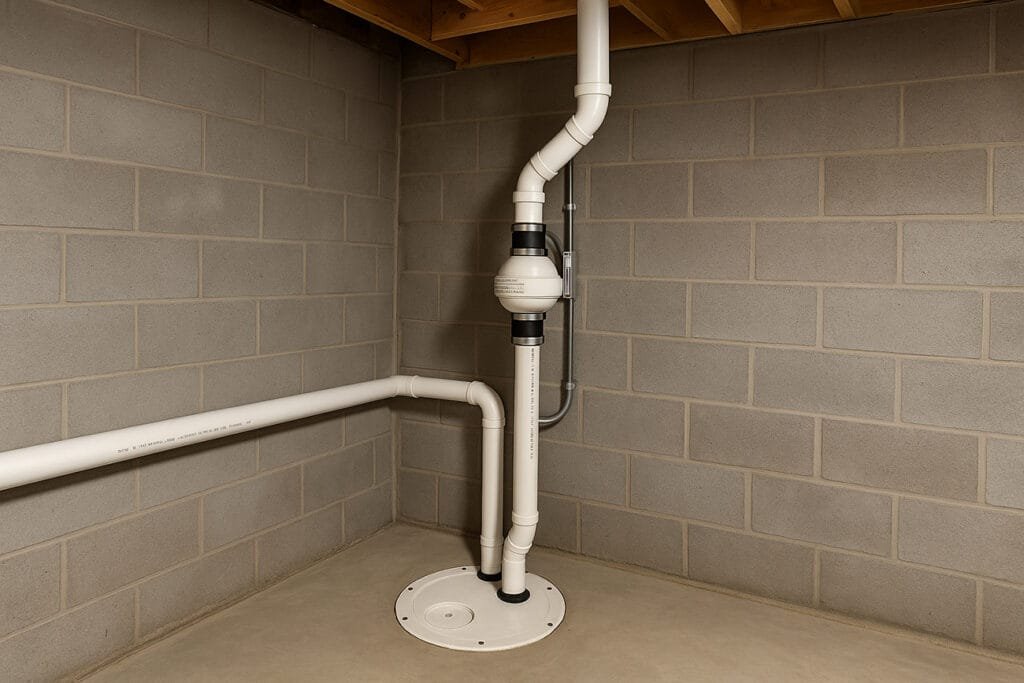
Most Terre Haute homes that require radon control use a sub-slab depressurization (SSD) system. This setup creates a slight vacuum beneath the concrete slab, pulling soil gas toward a suction point and venting it safely above the roofline, well away from windows or soffits. The system runs continuously and quietly, maintaining balanced pressure to keep radon out of your breathing zone.
Core components that matter
- Suction point cored through the slab or tied into existing interior drain tile for maximum sub-slab communication
- Smooth-wall PVC riser with solvent-welded joints, clean routing, and minimal elbows to maintain airflow
- Quiet, properly sized mitigation fan rated for outdoor or attic installation to draw soil gas consistently
- Discharge termination extending above the roofline and clear of openings to meet code and ensure proper venting
- Sealed sump lid and slab penetrations that prevent make-up air leaks and help maintain suction under the floor
- Simple U-tube manometer mounted in a visible spot so homeowners can confirm the system’s vacuum at a glance
How the system works in practice
The fan lowers air pressure under the slab, creating a controlled path for radon to exit through the PVC stack. Air from the soil moves toward the suction point instead of up through cracks or pipe penetrations. Because the fan operates continuously, radon concentrations remain stable year-round, regardless of weather, soil moisture, or HVAC operation.
Best practices for Indiana installations
- Position the suction point near mechanical rooms or sumps to minimize visible piping
- Keep the fan outside the living space or in the attic to reduce noise and simplify service
- Use schedule-40 PVC and properly glued joints for airtight integrity
- Verify flow with a U-tube or digital gauge, and label all components for inspection
- Route the discharge to terminate vertically above the roof and away from windows, decks, or soffit vents
Plan it during finishing to save time and money
It’s faster, cleaner, and cheaper to integrate radon mitigation while framing is open. With studs exposed, we can core the suction point, hide the vent stack, and pre-wire the fan without opening finished drywall later, keeping your Terre Haute project on schedule and looking intentional.
How we rough-in an SSD during a basement finish
- Place the suction point near the mechanical room or sealed sump to maximize sub-slab communication and shorten pipe runs.
- Route schedule-40 PVC in an interior chase (under stairs or next to utilities) with minimal elbows for smooth airflow and a clean finish.
- Mount the mitigation fan outdoors or in the attic for low noise and service access, then terminate the vent above the roofline away from windows/soffits.
- Coordinate a dedicated electrical circuit and labeled disconnect with the electrician so the fan has reliable power and simple maintenance.
Why pre-planning pays off
- Fewer penetrations and shorter runs reduce pressure losses, helping the fan maintain stable negative pressure under the slab.
- Hiding the riser inside framing preserves the design of finished spaces and avoids visible exterior stacks.
- Pre-sealing slab cracks, pipe penetrations, and the sump lid improves sub-slab depressurization performance and lowers make-up air leaks.
HVAC balance, humidity, and indoor air quality
A radon system runs quietly in the background, but comfort and health in a finished basement still come from balanced airflow and stable humidity. Aim for 45–50% RH year-round with a dehumidifier on a permanent drain, and make sure air can circulate with a real basement return, not just added air supplies.
What “balanced” looks like in a Terre Haute basement
- Add at least one true return-air pickup in the basement zone so the system can pull from the space, not just push air into it.
- Aim supply registers for long throw across exterior walls and cold surfaces to wash away cool boundary layers and reduce condensation risk.
- Keep duct runs sealed (mastic/tape), size branches with Manual D principles, and avoid excessive elbows that raise static pressure.
- If the main system can’t cover the load, use a ductless mini-split or dedicated zone for independent heating/cooling.
Humidity control that actually works
- Target 45–50% relative humidity; below ~40% in winter can feel too dry, above ~55% in summer invites musty odors and microbial growth.
- Choose a dehumidifier sized to square footage and leakage; land the drain to a condensate pump or floor drain so you’re not emptying buckets.
- Insulate cold water lines and metal ducts to prevent condensation; vent bath fans outdoors and run them 20–30 minutes after showers.
Easy IAQ upgrades for finished basements
- Use MERV 11–13 filtration (check blower limits) to reduce dust, allergens, and fine particles.
- Keep pressure neutral: avoid closing too many upstairs registers, which can starve the basement or spike static pressure.
- Consider a continuous or scheduled low-speed fan mode to mix air and prevent stratification between floors.
- If you cook or work out downstairs, monitor CO₂ and RH with a simple sensor to confirm ventilation and dehumidification are doing their job.
Local cost and timeline expectations
Most single-point SSD systems go in quickly once we confirm slab thickness, interior drain tile access, and a clean vent route. If framing is open and the sump is already getting a sealed lid, installation is faster and less intrusive. After startup, we verify suction on the U-tube manometer and schedule a follow-up radon test to document results across typical weather swings.
What drives cost in Terre Haute basements
- Access to interior drain tile vs. coring a new suction point
- Pipe routing complexity (hidden interior chase vs. exterior run)
- Fan size and location (attic or exterior), electrical distance to a dedicated circuit
- Sealing scope: crack repair, sump lid replacement, pipe collars, rim-joist sealing
- Finish work impacts: drywall patches, paint touch-ups, exterior roof penetration
Typical timeline (efficient sequence)
- Site walk + test review, confirm route and suction location
- Sealing work (cracks, penetrations, sealed sump lid)
- Core suction point or tie into drain tile; run schedule-40 PVC
- Mount mitigation fan and terminate above roofline
- Electrical hookup with labeled disconnect; system startup
- Manometer reading and homeowner orientation
- Follow-up radon test to validate performance
Ways to keep budgets tight
- Plan the riser path during finishing so the stack hides in framing with minimal elbows
- Combine sealing tasks with your other basement prep (crack fill, sump lid, rim-joist air sealing)
- Use the shortest practical run to reduce pressure losses and allow a smaller, quieter fan
Frequently Asked Questions On Basement Radon Testing & Mitigation
What are normal radon levels in Indiana homes?
Most Indiana basements test between 1.5 and 5.0 pCi/L, depending on soil and season. Anything at or above 4.0 pCi/L is considered the EPA’s action level, meaning mitigation is recommended. Even 2–4 pCi/L may warrant sealing and ventilation during finishing.
Is radon worse in winter in Terre Haute?
Usually. When homes are closed and the furnace runs, negative pressure increases stack effect, pulling soil gas through cracks, drains, and sumps. That’s why winter testing gives a realistic worst-case reading.
How much does radon mitigation cost locally?
Most single-suction systems in West-Central Indiana fall between $1,200 and $2,000, depending on layout, drain tile access, and routing. Larger or complex foundations may require multiple suction points or higher-capacity fans.
Can a dehumidifier or HVAC system remove radon?
No. While dehumidifiers help control moisture and mold, radon requires a dedicated venting system. However, good airflow balance and humidity control improve indoor air quality and support overall comfort.
Can radon be reduced in a finished basement without tearing it apart?
Yes. A sub-slab depressurization (SSD) system can often be retrofitted with minimal drywall disruption. The fan, vent pipe, and suction point can be added through mechanical areas or closets while maintaining a clean appearance.
Does sealing cracks alone fix the problem?
Sealing helps, but rarely lowers levels enough by itself. It’s best combined with a powered SSD system that draws soil gas below the slab and vents it outdoors. Sealing simply supports consistent suction and reduces make-up air leaks.
Do radon systems use a lot of electricity?
No. A typical mitigation fan draws 50–100 watts, roughly the same as a light bulb. Annual operating cost is usually under $100, and fans often last 7–10 years.
How often should I re-test for radon?
Re-test after installing or servicing your system, after major HVAC changes, or every two years. Seasonal shifts, foundation work, or duct changes can affect results.

Need further assistance?
Unsure about something? Get in touch with us for a personalized consultation.
Ready to make your basement safer without tearing up finished walls
We’ll handle testing, seal critical gaps, and install a quiet sub-slab depressurization system with a sealed sump and clean vent routing, then verify results with a follow-up radon test. If you’re in Terre Haute or nearby Vigo, Vermillion, or Parke counties, get a fast, local quote and a clear plan to keep your basement’s air clean and comfortable year-round.
Serving Terre Haute, Clinton, Rockville, and surrounding areas.
